
Top 7 Visual Field Analyzers: Which Device is the Smartest Investment for Your Practice?
Clear vision is a vital conduit to the world, and early diagnosis of conditions is crucial in the fight against disease and symptom management, making ophthalmology a key player. Appropriate tools, such as visual field analyzers, can make diagnosing conditions like glaucoma easier, faster, and more efficient than ever.
Visual field analyzers, the current gold standard for diagnostics, offer a range of options. Selecting the right one for your practice can significantly improve patient outcomes and clinic productivity. This choice can enable you to treat patients effectively while streamlining operations.
Suppose you are in the market for a new visual field analyzer. This guide will help you understand the essential factors in selecting the best device and provide an overview of today’s top devices.
Visual Field Analyzer (VFA): An Overview
Visual field analyzers map a patient’s visual field, particularly peripheral vision, to detect and diagnose conditions such as glaucoma. They are an essential tool in many practices, from GP offices to Optometrists.
With so many different practices capable of diagnosing eye conditions, you must choose the right model for your needs. Those in general practitioner fields or pediatrics will need a different solution than a fully-focused eye doctor.
Choosing the Right Visual Field Analyzer: Key Factors to Consider
Choosing the right visual field analyzer is critical for enhancing diagnostic accuracy, patient satisfaction, and overall practice efficiency. Each device has its own special features and benefits to meet various needs and budgets.
There are several factors that should go into your selection process. When considering these criteria, here’s a quick rundown of factors to keep in mind:
General Considerations
- Measurement accuracy
- Testing speed vs accuracy
- Patient comfort
- Reputation of the brand
- Internal database size
- Total cost of ownership over the lifetime of the product
These are just surface-level considerations to help you select among the different models. Do keep in mind the scope of your practice, however.
A general practitioner, for example, may prefer convenience over a comprehensive testing tool, since their next step would be to refer their patient to a specialist. Optometrists and other specialists, however, will need the full range of testing capabilities at their disposal.
Technical Considerations
As for more technical considerations, here are a few factors to keep in mind when selecting your visual field analyzer:
- Stimulus size and type: do you need flickering or static light for testing? Consider patient comfort
- Testing strategies: what level of diagnoses and testing do you need to complete?
- Database size: how large does the in-machine database need to be for your setup/
- Dynamic range: wider rangers provide more comprehensive testing, but sacrifice portability
- Fixation monitoring: can the device fix on the patient’s eye, avoiding issues with blinking or eye movement during testing?
Top 7 Visual Field Analyzers in the Market 2024. What is the Best Visual Field Analyzer Model for Your Practice?

Choosing the right visual field analyzer is crucial for ensuring accurate diagnostics and efficient practice operations. This review examines the top five visual field analyzers. These analyzers excel in technology, user-friendliness, accuracy, and value for eye care practices.
Now that you know more about the different types of visual field analyzers, let’s get into the top models available today:
1. Humphrey Field Analyzer 3 Model 860 (HFA 3 860)
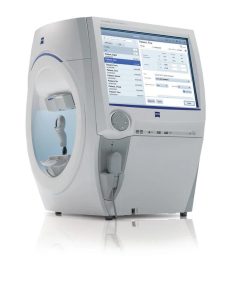
The Zeiss HFA 3 860 is a high-tech tool used in eye care to assess a person’s visual acuity. Created by Carl Zeiss Meditec, this tool is highly advanced for detecting and managing glaucoma and other vision problems. The device uses advanced technology to give accurate measurements, helping eye care professionals diagnose and track patients’ eye health.
HFA 3 860 is the gold standard of visual analyzers. It features guided progression analysis, SITA faster, and 24-2C, making it ideal for in-depth, detailed diagnostics that go beyond diagnosis and help practitioners treat and manage conditions. Thanks to the HFA 3’s Guided Progression Analysis (GPA), which provides your patient’s entire visual field history to streamline diagnostics by comparing previous test results.
Pros
- Advanced Testing Options: Advanced testing, thanks to GPA and SITA, is faster and more precise
- Extensive database:a large database stores full patient histories for clinical confidence
- Integration: seamlessly integrates with a wider network of systems, including your EMR.
Cons
- High Cost: This model is one of the most expensive options on the market, making it a significant investment
- Learning curve: The high complexity of this model requires training to master
- Size: requires a dedicated space in a clinic to store.
2. Haag-Streit Octopus 600 Pro Computer Perimeter ($7,888.00)

The Octopus 600 Pro by Haag-Streit is easy to use and provides advanced perimetry for modern eye care. A user-friendly tool. It offers essential features for modern eye care.
Key Features:
- Pulsar perimetry for early glaucoma detection.
- EyeSuite software for comprehensive data analyzing and reporting.
- Compact design with a large touchscreen interface.
Benefits:
- Early Detection: Pulsar perimetry technology enhances the detection of early glaucoma stages, crucial for timely intervention.
- Comprehensive Analysis: EyeSuite software enables detailed analysis and the generation of customizable reports, aiding accurate diagnostics and patient management.
- Easy to Use: The large touchscreen and compact design make it simple and space-saving, perfect for busy practices.
The Octopus 600 Pro is a must-have for ophthalmologists because of its advanced features and easy-to-use design. It helps detect glaucoma accurately and early. It works well with other systems, helping eye care run smoothly.
Octopus Perimeter is another advanced diagnostic analyzer that’s ideal for specialist clinics. This model features a user-friendly interface and advanced capabilities that let you diagnose and treat visual conditions with ease and confidence.
Its unique technology makes it an excellent choice for practices that need quick, reliable screening tools. Like the HFA, this unit also includes a progression analysis tool that indicates significant changes to improve workflows. It also pauses when the eye is misaligned, giving you a clear and comprehensive overview of the eye.
Pros
- Cluster analysis: makes it easier to detect patterns, even small ones, in visual field defects
- Automated reporting: speeds up reporting, saving you time
- Ease of use: easier to use than other comprehensive models
Cons
- Cost: High cost means it is best suited for specialist clinics
- Size: One of the largest models in the list.
- Learning curve: while user-friendly, getting the most out of this device requires training.
3. Optopol PTS 925W / 925Wi Automated Compact Perimeter
Need a perimeter that packs a punch, delivering high-quality visualizations without taking up too much space? Then, the Optopol PTS 925W or 925Wi may be just the visualizer you were looking for.
This automated solution provides specialists with precise, fast testing using the latest visual field testing approaches. It’s explicitly designed to save you time while delivering cutting-edge precision, for reliable results time after time.
Thanks to its ZETA Fast Threshold strategy, 24-2 field testing can be finished in less than 3 minutes. The 170° horizontal and 110° vertical testing ranges mean you can quickly test 30-2, 24-2, and 10-2 fields in a flash.
Pros
- Blink control: a test is put on hold during a blink to boost patient comfort
- Eye tracking: automatically adjusts to accommodate eye tracking for sharper results
- Built-in test fields and programs: predefined programs speed up diagnostics
- Seamless integration Easily connect to your DICOM, GDT, or EMR systems
Cons
- Smaller database size means it must be connected to your EMR or wider system
- Better suited for satellite offices than full-scale testing facilities
4. TOPCON TEMPO Perimeter Visual Field Screening
If your goal is speed, then the TOPCON TEMPO has your back. This perimeter is 39% faster than standard automated perimetry models. Don’t worry, however, as it’s still highly accurate and will perform as well as the SAP1 model, with high repeatability, giving you results you can bank on.
The biggest draw, of course, is its range of testing strategies. With this device, you can test AIZE, AIZE-Rapid, Full-threshold, two-zone, AIZE EX, and AIZE-Rapid EX strategies in a flash. Thanks to the binocular design, patients’ comfort is well assured, helping them remain still during testing. This model also tests a greater range of patterns, including 30-2, 24-2, 10-2, 24plus (1-2) and 24plus (1).
Pros
- User-friendly: Easy to use for clinicians, comfortable and fast for patients.
- Affordable: It’s one of the more affordable models on the market
- Speed: Very fast, making it ideal for satellite or GP practices
- Compact: Easy to store away
Cons
- Limited Advanced Features: This device is less suited for detailed diagnostic work
- Accuracy: While accurate, higher-end alternatives provide more precise results
5. PalmScan VF2000 G2 ($3,999.00)

Bring your practice into the future with the PalmScan VF2000 G2. This device, which resembles a virtual reality headset, is paving the way for more comfortable, convenient diagnostics. Thanks to its revolutionary compact design, it’s ideal for satellite clinics, GP offices, and even field testing.
Though small, this device packs in the latest internal optics, and offers full and fast thresholds VF testing, FDT testing, stereopsis, contrast sensitivity, and more. The device is also fully self-guided to help smoothly take the patient through the comfort test in the language they prefer.
Pros
- No internet needed: making it ideal for field testing
- User friendly operation: for patient comfort and usability
- In line with the latest CPT coding standards
- Complaint with ADA
Cons
- Limited testing range: this is better suited as an initial diagnostics tool than an in-depth testing device
- Battery life: As its wireless, you need to continually charge it.
6. Kowa AP-7000 Automated Perimeter ($2,222.00)

If you are a specialist clinic and need an in-depth diagnostics tool that does it all, then the Kowa AP-7000 may be just what you’re after. This device features full-threshold modes, providing full macular, central, and peripheral coverage. Its wide 80° field of view enables swift, effective testing of the entire visual field.
This device offers both threshold and screening modes, to suit the type of diagnostic test you are running to a T. Fundus images, OCT, and SLO can be linked for in-depth testing of specific retinal locations. Thanks to its in-depth testing capabilities, this device can be used for GHT, VFI, Anderson’s Criteria, and more.
Pros
- Highly accurate: provides some of the most accurate and in-depth measurements from models in this list.
- Feature-rich: highly customizable to effectively diagnose multiple conditions from glaucoma to other neuro-ophthalmic conditions.
Cons
- Steep learning curve: requires more training to use to its fullest, making it less ideal for satellite clinics or field testing.
- Cost: a higher price point limits this device to specialist practices.
- Size: It has a significantly larger footprint than other models in this list.
7. OCULUS Centerfield 2 Perimeter ($2,777.00)

Oculus Centerfield 2 Perimeter is a revolutionary approach to virtual reality (VR) fitness and training. This program uses advanced VR technology and specific physical exercises. It can uniquely improve physical performance, mental focus, and overall well-being. Unlike traditional fitness routines, Oculus Centerfield 2 Perimeter provides an immersive experience that engages users on multiple levels, making workouts more enjoyable and effective.
This self-contained device can be used across multiple lighting conditions, making it ideal for satellite clinics and other field-testing settings. Despite its portability, this device is packed with features, delivering reliable results for detecting abnormalities.
This device connects quickly and easily via USB to any compatible port, including your laptop or PC. It also integrates seamlessly with your wider network, so you can boost its capabilities with more advanced IT systems and benefit from a larger database. Thanks to its wide range of testing patterns (30-2, 24-2, 30 x 24, and 10-2), this device is ideal for diagnosing pre-defined glaucoma, macula, screening, and neurological tests.
Pros
- Fast: short 200ms stimulus test keeps patients comfortable.
- Adjustable: The patient can adjust the headrest for comfort.
- USB connectivity: allows for easy connection to your wider setup.
- Compact design: makes it ideal for field testing.
Cons
- Small database: you must have this device connected to save information, as the internal database is small.
- Learning curve: Not as straightforward to use as some other field models.

Final Thoughts
Investing in the right visual field analyzer is essential for field testers, satellite offices, GP practitioners, and specialists. By understanding what your patients need most, depending on your clinic type, you can start to narrow down your list.
Those in specialist clinics will need an effective, robust glaucoma detection management system, which means the larger, less portable models will be ideal. This is because they include larger diagnostic and testing tools, as well as the databases necessary to make change detection a breeze.
On the other hand, those in satellite or field clinics need a small and portable testing set. This makes FDT tools and the like preferred, since they quickly give you the answers you need without taking up too much space.
Choosing the right model for your practice will always boil down to function, affordability, and, finally, reputation. By choosing one of these models, you are sure to end up with a diagnostic tool that quickly helps you identify and diagnose glaucoma and similar conditions in a wide variety of settings.